1. Purpose
This Carbon Reduction Plan (CRP) outlines Land + Water Services Limited’s approach to carbon reduction.
Carbon Dioxide (CO2) is produced when fossil fuels such as gas, oil, or diesel are combusted to produce energy for heating, electricity generation, material production, and transport. Carbon emissions are categorised as:
Scope 1 those produced directly by burning fuel on site such as gas for heating and diesel in vehicles.
Scope 2 those generated through the off‐site generation of electricity.
Scope 3 those arising indirectly due to core operations, including the procurement of goods, business travel and staff commuting.
This plan identifies the baseline established emissions, in accordance with PPN 006, and details the implementation of targets to reduce carbon intensity. It is supported by objectives set out in our third-party-accredited ISO 14001 Integrated Management System.
2. Scope
This Carbon Reduction Plan addresses Land + Water Services’ direct Scope 1 emissions, indirect Scope 2 emissions, and the following indirect Scope 3 emissions:
Category 4 – Upstream Transport & Distribution
Category 5 – Waste generated in Operations
Category 6 – Business travel
Category 7 – Employee commuting
Category 9 – Downstream Transport & Distribution
It applies to all of Land + Water Services’ activities for which they have operational control, including projects and offices.
3. Commitment to Achieving Net Zero
Land + Water Services Limited recognises that the impacts of climate change will disrupt the natural, economic, and social systems we depend on. This disruption will impact global food security, damage infrastructure, and jobs, and harm human health. Consequently, we are fully committed to supporting the UK Government’s ambition of achieving Net Zero carbon emissions by 2050 and are actively collaborating with key Supply Chain Partners and Clients to do the same.
4. Baseline Data
Baseline emissions are a record of the greenhouse gases that have been produced in the past and were produced prior to the introduction of any strategies to reduce emissions. Baseline emissions are the reference point against which future emissions reduction can be measured. The baselines were determined using information primarily gathered through Land + Water’s Accounts system. The data recorded was reviewed, and 2019 was established as the baseline year for Scope 1 and 2 emissions, and 2023 as the baseline year for Scope 3 emissions.
| Carbon emissions
(tCO2e) |
Baseline Year:
2019 |
Baseline Year:
2023 (Scope 3) |
Current Year:
2025 |
| Scope 1 | 1790 | 1087 | |
| Scope 2 | 12 | 4 | |
| Scope 1 and 2 combined | 1802 | 1091 | |
| Scope 3 | Not recorded | ||
| Cat 4 Upstream Transport & Distribution | 136 | 186 | |
| Cat 5 Waste (ex transport) | 567 | 497 | |
| Cat 6 Business Travel (ex hotels) | 1 | 3 | |
| Cat 7 Employee Commuting (ex home working) | 20 | 24 | |
| Cat 9 Downstream Transport & Distribution
Scope 3 combined |
0
724 |
0
710 |
We note that Scope 3 emissions can represent up to 80% of an organisation’s carbon emissions and are cognisant that Total Carbon Emissions reported currently within this plan exclude some of those higher emission activities, including Cat 1 Purchased Goods and the transportation of Waste in Cat 5.
It is also recognised that emissions associated with our supply chain are likely to be significant and it is acknowledged that these are not currently recorded.
5. Carbon Reduction Targets
To continue our progress to achieving Net Zero by 2050, we have adopted the following carbon reduction target:
| Target | Progress to date |
|
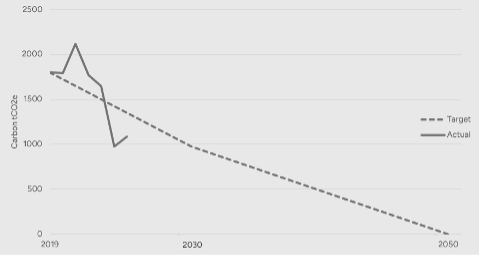
To reduce emissions in line with Paris Agreement goals on a 1.5°C pathway. To align with the pathway our near-term science-based target is to reduce our Scope 1 & 2 carbon emissions from our 2019 Baseline of 1802tCO2e by 46% to 973tCO2e by 2030. To become a Net-Zero carbon emissions business by 2050 – Direct Emissions Scope 1 & 2. As an SME, we commit to measure and reduce our Scope 3 emissions. |
40% (715tCO2e) reduction in Scope 1 & 2 carbon emissions from our 2019 Baseline.
2% (14tCO2e) reduction in Scope 3 carbon emissions from our 2023 Baseline. |
Progress against this target can be seen on the graph below:
6. Carbon Reduction Projects
The following environmental management measures and projects have been completed or implemented since the 2019 baseline. The carbon emission reduction achieved by these schemes equates to a 40% reduction against the 2019 baseline (70% per £ million turnover).
Microsoft Teams: has been utilised within the business to enable internal and external meetings to be held online, minimising vehicle movements.
Electrification of car fleet: greater electrification of the company car policy has encouraged take-up of electric or hybrid vehicles by staff.
EV chargers: are available at half of our regional offices, evidencing a reduction of 8.4tCO2e across the wider business in 2025.
Idling campaign: behaviours learned during our idling campaign in 2023 are ongoing throughout the business, which is continuing to see reductions in carbon. Toolbox talks are frequently delivered to teams to ensure new staff are aware of the initiative. Our key supply-chain and enabling partner within the Land + Water Group now operates automatic engine switch-off if plant has been idling for 5 minutes to further reduce idling emissions.
Minimum plant standards: including Stage V engines, were implemented down our supply chain in 2023.
HVO: has been offered to clients since 2022. The use of HVO on construction sites in 2025 has resulted in a reduction of site fuel carbon by 286 tCO2e compared to diesel. This reduction contributes significantly to L+WS’ progress towards the 2030 target. If the use of HVO changes in the future, the carbon emissions from site fuels will fluctuate accordingly. Importantly, without utilising HVO as an alternative fuel source in 2025, the increase in diesel-related tCO₂e emissions does not alter our trajectory towards achieving our carbon reduction targets for 2030 and beyond.
Waste reduction: 2023 saw the soft launch of our internal material re-use platform “LAWbay”. During 2024, LAWbay continued to be utilised, but further uptake was desired going forward. In 2025, LAWbay prompts were added to our temporary and permanent works design briefs. Furthermore, in 2025, L+W launched our Sustainability Plan, outlining waste KPIs that focus on reducing soil and skip waste sent to landfill by implementing the waste mitigation hierarchy.
Diesel-free sites: Work with our procurement and supply chain to implement diesel-free welfare, power, and plant solutions where feasible. This includes exploring alternative technologies such as hydrogen-powered welfare units, hybrid and electric plant. Increasing the use of these solutions will help reduce site-based carbon emissions, improve air quality, and support our wider decarbonisation targets. L+W have saved over 160tCO2e in 2025 by utilising solar, rainwater harvesting and smart telematics eco welfare units on site when compared to diesel alternatives.
In the future, we will continue to implement further measures such as:
Over 45% of our direct emissions (GHG scope 1) come from our vehicle fleet.
Currently, electric vehicles make up 19% of our company car fleet, with hybrids representing a further 61%, highlighting our ongoing transition towards lower-emission transport solutions. We aim to transition our entire company car fleet to electric or zero-emission models by 2030, where it is the best technical and economic solution and will pursue other ultra-low-emission solutions where EVs are not viable.
We operate a fleet of 67no. diesel vans for the workforce. During 2023, a trial of an electric van was conducted, but due to the site locations and mileage, there were some challenges. Land + Water Group has identified opportunities for the use of electric vans and is set to trial five vehicles. The findings from this trial, alongside continued improvements in battery technology, will inform Land + Water Services’ assessment of electric vans as a future fleet solution. We aim to transition our entire van fleet to electric or zero-emission models by 2035, where it is the best technical and economic solution, and will pursue other ultra-low-emission solutions where EVs are not viable. While we wait for electric vans to become more suitable for our business we are starting to swap out diesel vans for petrol and evaluating whether operatives require a van or whether a car-derived van would be more appropriate.
We are reviewing our organisational structure to optimise geographic working, reduce vehicle journeys, and increase vehicle sharing throughout 2026.
EV charge points will be available at all our regional offices by 2026, following which charging options on construction projects will be evaluated.
Review and enhance the fleet fuel policy to reduce fuel usage and maximise the benefits of hybrid vehicle technology across the fleet to ultimately reduce the carbon of our vehicle fleet.
The operation of non-road mobile machinery on our construction sites accounted for nearly a third of our direct emissions (GHG scope 1) in 2025.
Land + Water seeks to switch from running on fossil fuels to sustainable alternative fuels such as Hydrotreated Vegetable Oil (HVO), Gas to Liquid (GTL), or other emerging alternatives by 2030.
We aim to undertake a phased reduction in our supply chain’s fleet of non-road mobile machinery to zero- or ultra-low-emission models by 2035.
We are continuing to see the benefits of our idling campaign and will continue until behaviours are fully embedded. Our supply chain has invested in telematics to enable those conversations with, and evidence for, our workforce. To further reduce idling, companywide incentives for sites with the least amount of idling will be explored.
We are transitioning from generators reliant on fossil fuels, which provide temporary power supplies to projects, to hybrid power systems that provide sustainable (hybrid, hydrogen, and solar) power solutions, or direct connection to the grid utilising renewable power supplies where practicable. While two of our offices have solar panels, we will investigate increasing our solar energy harvesting on remaining offices and workshops.
Since reporting our 2023 baseline year for 5no GHG Scope 3 emissions, we will continue to:
Improve our calculating methodology for Category 4. Although it has improved since 2023, we still need to better understand and calculate our upstream transportation and distribution through engagement with the supply chain to increase the accuracy of data and identify potential reduction pathways.
Engage directly with our top three suppliers with the greatest influence on our Scope 3 emissions to improve the accuracy of our calculations and assumptions.
Better understand and categorise the types of waste streams we generate and learn how we could implement the waste hierarchy to maximise reductions of upstream and downstream interactions with our waste and the associated Cat 5 GHG emissions.
On a more general note, we propose to continue to:
Train and educate employees on carbon reduction practices.
Increase use of low-carbon alternative materials (concrete, aggregate and steel etc) or sourcing sustainably produced/recycled products.
Engage with our procurement team, suppliers, subcontractors, and clients to achieve carbon reduction goals.
7. Declaration & Sign Off
This Carbon Reduction Plan has been produced in accordance with the requirements of PPN 006, associated guidance, and the Technical Standard for completion of Carbon Reduction Plans.
Emissions have been reported and recorded in accordance with the published reporting standard for Carbon Reduction Plans and the GHG Reporting Protocol corporate standard and uses the appropriate Government emission conversion factors for greenhouse gas company reporting.
Scope 1 and Scope 2 emissions have been reported following SECR requirements, and the required subset of Scope 3 emissions have been reported in accordance with the published reporting standard for Carbon Reduction Plans and the Corporate Value Chain (Scope 3) Standard. This Carbon Reduction Plan has been reviewed and signed off by the board of directors.
Signed by Kevin Kirkland, Managing Director of Services on 14th August 2026